Why Choose Sheet Metal Manufacturing for Global Sourcing?
Why Choose Sheet Metal Manufacturing for Global Sourcing?
Global sourcing is no longer about finding the lowest quotation. It is about securing repeatable quality, stable capacity, and measurable delivery performance. Sheet metal manufacturing supports these goals through standardized cutting, bending, punching, welding, and surface finishing processes. A well-managed supplier can produce enclosures, brackets, panels, and precision frames with consistent dimensions across multiple production batches.
“Quality comes not from inspection, but from the improvement of the production process.” — W. Edwards Deming, a leading manufacturing quality authority.
This principle remains highly relevant to sheet metal manufacturing. Reliable suppliers document material grades, tooling conditions, bend allowances, weld procedures, and inspection results. They also provide practical evidence, such as first-article samples, dimensional reports, and photographs of packed components. A steel enclosure should arrive with clean edges, protected surfaces, and holes aligned with the assembly drawing. Small details become expensive when sourcing crosses borders.
The advantages are tangible. Buyers may access specialized equipment, broader production capacity, and competitive labor structures. They can also reduce pressure on internal facilities during seasonal demand. However, global sourcing is not effortless. Communication gaps, changing specifications, packaging damage, and unexpected rework can weaken the business case. This deserves honest attention.
Cost alone is a weak guide.
My experience with supplier evaluations suggests a balanced approach: compare total landed cost, process capability, communication speed, traceability, and corrective-action discipline. Sheet metal manufacturing becomes a strategic sourcing choice when savings are supported by dependable engineering and transparent production control. There is no perfect supplier. Continuous review still matters.
What Is Sheet Metal Manufacturing in Global Sourcing?
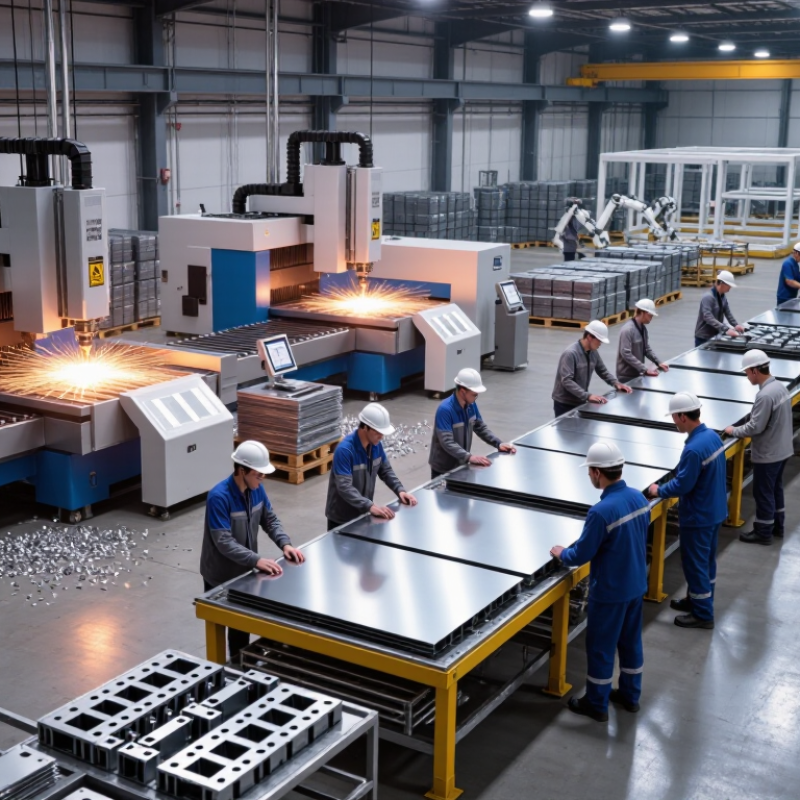
Sheet metal manufacturing converts flat metal sheets into precise three-dimensional components. Typical operations include laser cutting, punching, bending, welding, and surface finishing. Steel, aluminum, and stainless steel are common choices. A digital drawing becomes a real part through tooling, machine settings, and inspection.
The process looks simple. It is not. Material thickness, grain direction, bend radius, and springback can change the final dimensions. In global sourcing, suppliers should confirm these details before production. The World Steel Association reported approximately 1.89 billion tonnes of crude steel production worldwide in 2023. This broad supply base supports material availability, but quality still varies between mills and regions. Buyers should request material certificates, first-article samples, and measurable acceptance criteria.
Sheet metal also suits global sourcing because parts can ship flat or in compact assemblies. That can reduce packaging volume and simplify inventory planning. UNCTAD’s Review of Maritime Transport 2024 states that ships carry over 80% of world merchandise trade by volume. Transit delays therefore affect production schedules directly. A practical sourcing plan includes corrosion protection, export packaging, backup suppliers, and inspection before shipment. The overlooked detail is communication. A translated drawing may still hide a tolerance mistake. Experienced teams review bend sequences and test assemblies early. That extra step costs time, sometimes unnecessarily, but skipping it can create expensive rework.
Why Sheet Metal Manufacturing Supports Cost Efficiency
Sheet metal manufacturing can make global sourcing more cost-efficient when design, volume, and logistics are considered together. Parts are cut from flat stock, formed with repeatable tooling, and assembled with fewer operations. This can reduce labor time and material waste. In one sourcing review, tighter nesting lowered sheet consumption by nearly 12 percent. The saving was useful, but it depended on stable dimensions and accurate production drawings. A low unit price means little if rework fills the shipment.
Tips:
Request a detailed cost breakdown for material, cutting, forming, finishing, inspection, packaging, and freight. Compare suppliers using the same drawing revision. Ask for sample parts before approving a large order. Standard thicknesses and bend radii often reduce special tooling costs. Keep tolerances practical. Overly tight tolerances can add inspection time without improving function. Also review packaging, because scratched panels can erase savings during transit.
Sheet metal also supports flexible order planning. A supplier may produce prototypes, pilot batches, and recurring volumes using related processes. This helps buyers avoid expensive molds for simple enclosures, brackets, and covers. However, efficiency is not automatic. Complex bends, poor hole placement, or late engineering changes can increase scrap quickly. I have seen a seemingly efficient design require three setups instead of one. That mistake was preventable. Clear drawings, first-article checks, and documented inspection records make cost comparisons more trustworthy. They also give global purchasing teams stronger evidence when negotiating schedules and quality requirements.
How Global Suppliers Ensure Quality and Scalability
Sheet metal manufacturing is a strong option for global sourcing because suppliers can combine repeatable processes with flexible production. Cutting, bending, welding, and finishing can be documented and measured across facilities. Experienced suppliers usually confirm tolerances before quoting, rather than treating drawings as complete instructions. That small discussion prevents costly revisions later. Quality becomes visible through first-article checks, material certificates, weld inspections, and dimensional reports. However, no sourcing plan is perfect. A supplier may meet dimensions but miss a surface expectation if the specification is vague.
Scalability depends on more than machine capacity. Reliable suppliers build production around approved samples, controlled work instructions, and traceable batch records. They also assess tooling life, operator training, and inspection frequency before volume increases. A pilot order can reveal packaging damage, uneven coating, or slow feedback. These details matter when shipments cross borders and schedules cannot absorb repeated delays. In my experience, clear escalation contacts improve response time. Still, larger orders can expose weak planning. Capacity promises need evidence, not optimistic emails.
Tips:
Request a capability review before placing an order. Share critical dimensions, finish standards, annual demand, and acceptable variation. Ask how nonconforming parts are isolated and corrected. Review sample data, not only photographs. Keep one approved reference part for future comparison. Use staged orders when demand is uncertain.
What to Evaluate When Choosing a Sheet Metal Manufacturer
When choosing a sheet metal manufacturer for global sourcing, evaluate more than the quoted price.
Ask for evidence. Review equipment lists, material controls, and production records. A capable shop should explain how it handles laser cutting, bending, welding, finishing, and inspection. Match these processes to your drawings, tolerances, surface requirements, and expected annual volume. If the manufacturer cannot describe its inspection plan clearly, risks may appear later as warped panels or inconsistent holes.
Request sample parts made with the same materials and processes planned for mass production.
Measure critical dimensions independently when possible. Check edge quality, bend angles, coating coverage, and packaging strength. Quality certificates can support trust, but traceable records are more useful than attractive documents. Confirm calibration routines, lot tracking, corrective-action procedures, and the person responsible for final approval. Small details matter.
Communication also deserves practical testing.
Send a technical question and observe the response time, clarity, and willingness to challenge unclear specifications. A reliable partner should flag unrealistic tolerances or weak packaging before production begins. Review capacity, backup equipment, lead times, export experience, and compliance with destination-country requirements. Cost still matters, but the cheapest offer may hide rework, delays, or expensive freight. No supplier is perfect. I would rather see a documented weakness and a correction plan than receive confident promises without measurable proof.